Reggio Emilia vs. Montessori: What's the Difference — and Which Approach is Right for Your Child?
Both approaches respect children as capable learners. Here is how they differ - and why University Liggett School believes a Reggio Emilia-inspired beginning develops the human skills children need today and for the world ahead.
When families begin exploring early childhood programs, one word often feels familiar: Montessori. Reggio Emilia may be less widely known, but it is one of the world's most respected approaches to early childhood education - and it has much to offer children growing up in a rapidly changing world.
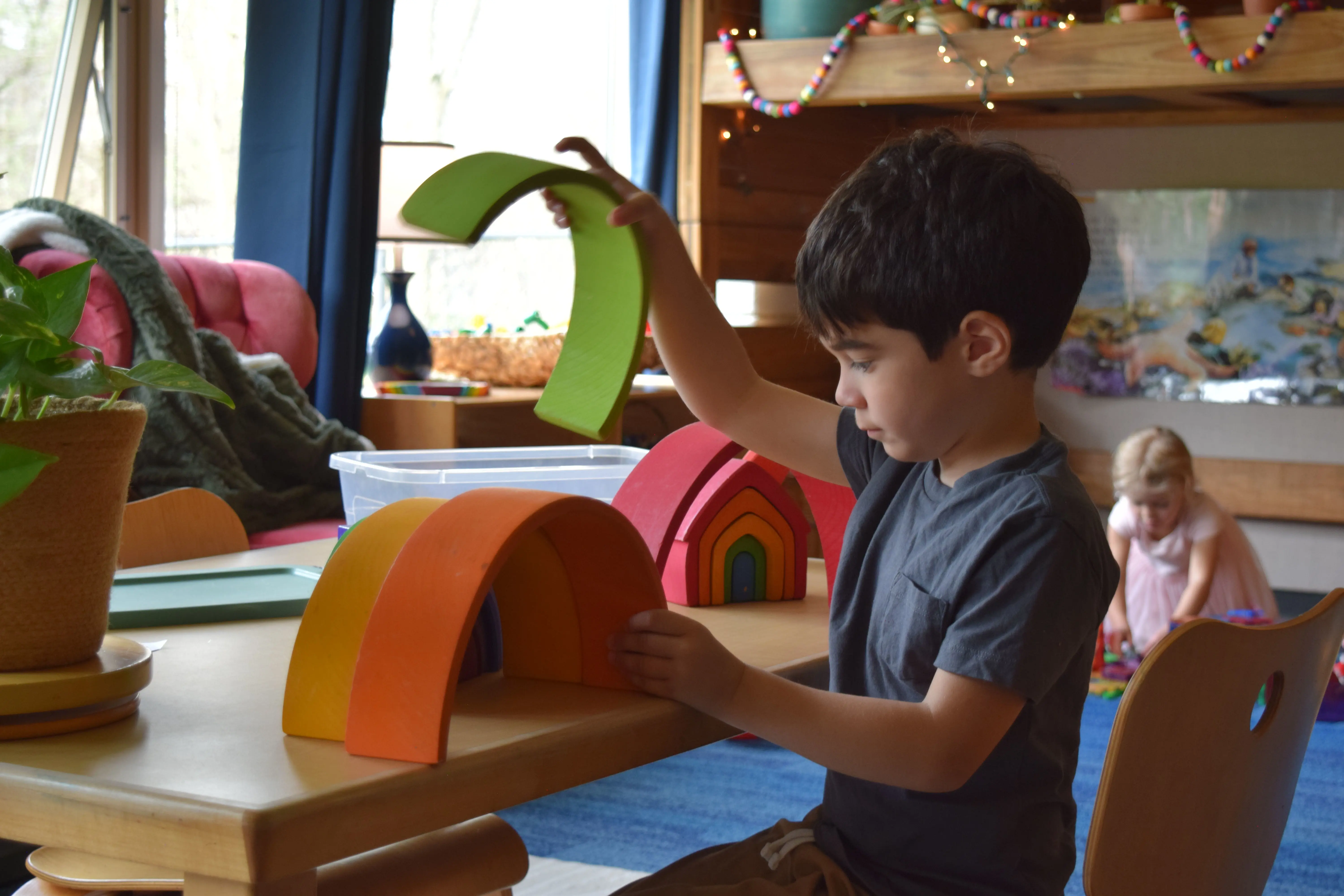
Both Montessori and Reggio Emilia began in Italy. Both reject the idea that young children should simply sit, listen and absorb information. Both respect children as capable learners and value thoughtfully designed environments, hands-on experiences and teachers who observe carefully.
The difference is not that one approach lets children explore while the other does not. It is how that exploration is organized, how learning develops and what role children, teachers, classmates and families play in the process.
At University Liggett School, our Early Childhood program combines the principles of Reggio Emilia with The Liggett Approach: a student-centered, inquiry-driven model that begins with each child's questions, ideas and potential. It is intentionally designed to develop not only foundational academic knowledge, but the skills children increasingly need to use that knowledge well: collaboration, communication, creativity, critical thinking, adaptability and problem-solving.
Montessori and Reggio Emilia at a glance
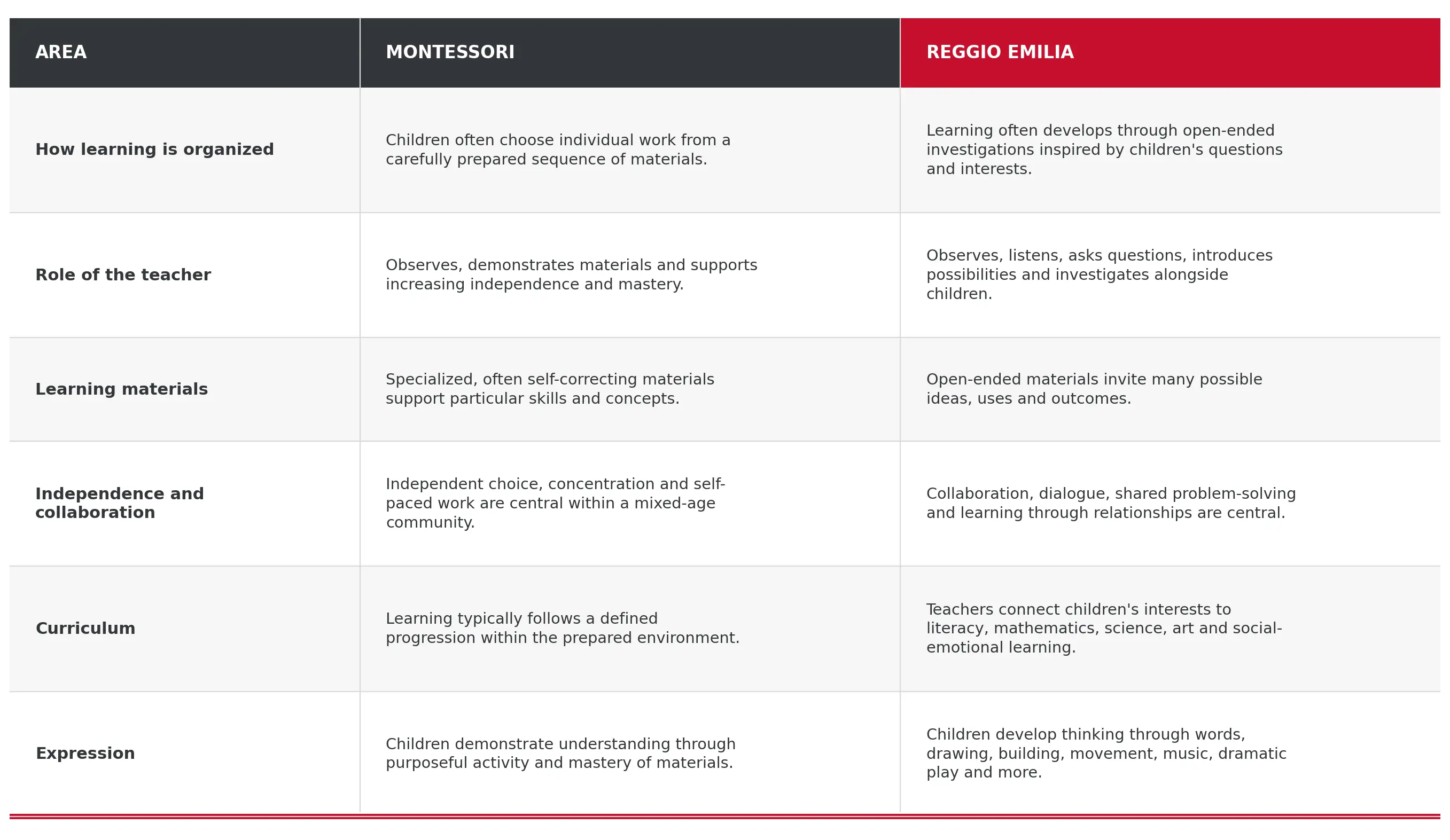
These are broad distinctions, not rigid rules. Individual schools interpret each philosophy differently, and excellent early childhood classrooms may draw from more than one tradition. What matters most is what children experience each day.
What does Reggio-inspired learning look like?
Imagine that several children become fascinated by shadows on the playground. In a Reggio-inspired classroom, that interest might become a sustained investigation.
Children could trace shadows, measure how they change, experiment with flashlights, create shadow drawings, build structures, tell stories, compare predictions and revisit their theories. Teachers would listen for the children's questions, introduce new materials and vocabulary, and find natural connections to science, mathematics, literacy and art.
The result is not unstructured play, and it is not a predetermined lesson with a single correct product. It is intentional teaching built around meaningful inquiry. Children learn foundational concepts while also learning to observe closely, explain an idea, listen to others, test a theory, revise their thinking and persist when the answer is not immediately clear.
Why the Reggio approach develops the skills children need today
The world our children are entering increasingly rewards people who can do more than recall the right answer. They need to ask strong questions, make sense of new information, communicate an idea, work productively with others and adapt when conditions change.
The World Economic Forum's Future of Jobs Report 2025, based on input from more than 1,000 employers representing over 14 million workers, identifies analytical and creative thinking, resilience, flexibility, agility, leadership and social influence, and curiosity and lifelong learning among the capabilities that are important now and continuing to rise in importance.
These capacities do not suddenly appear in high school, college or a first job. Their foundations are built in childhood - each time a child contributes an idea, listens to another point of view, experiments with a solution, recovers from frustration or discovers that a group can accomplish something no one child could have created alone.
1. It protects and develops curiosity
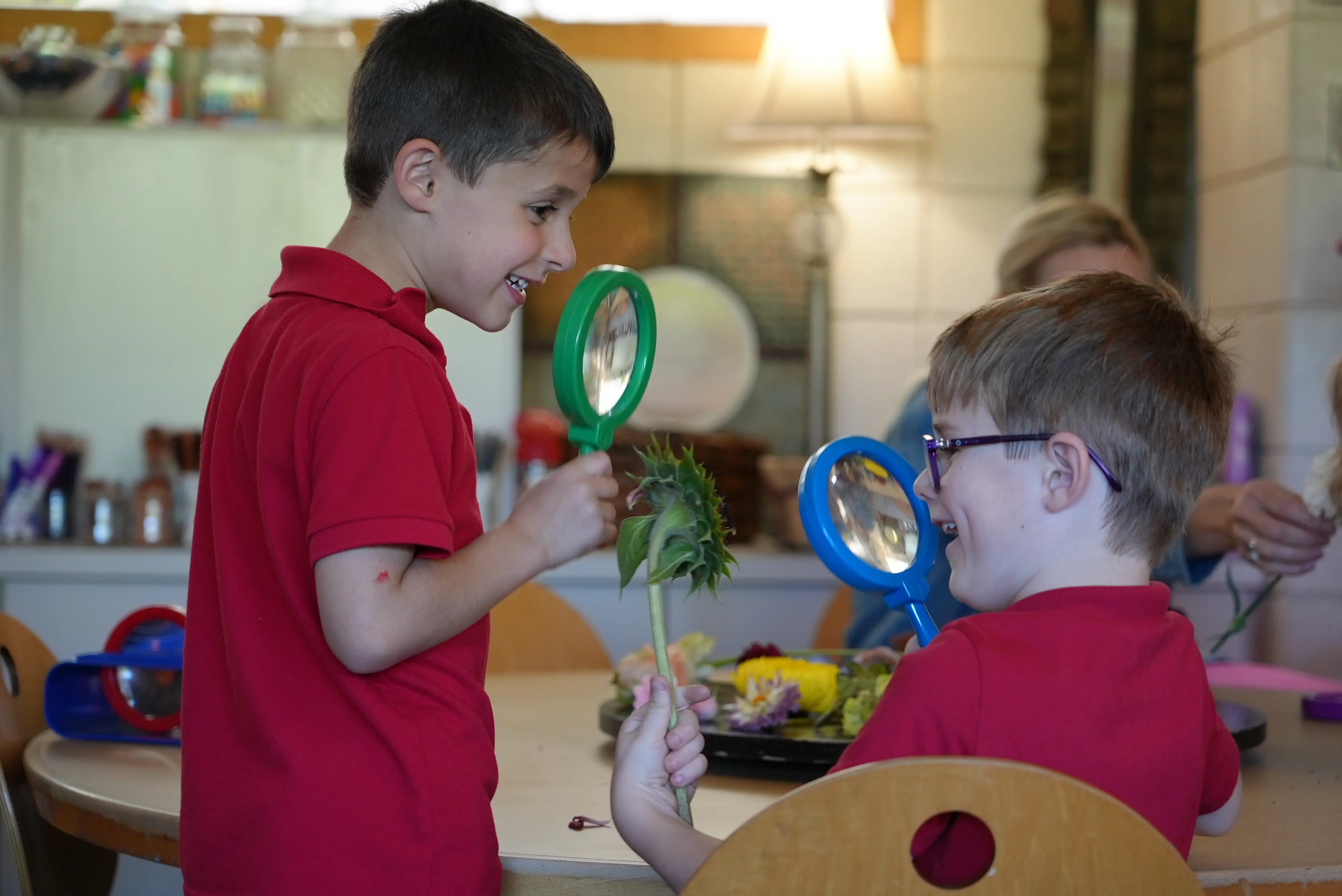
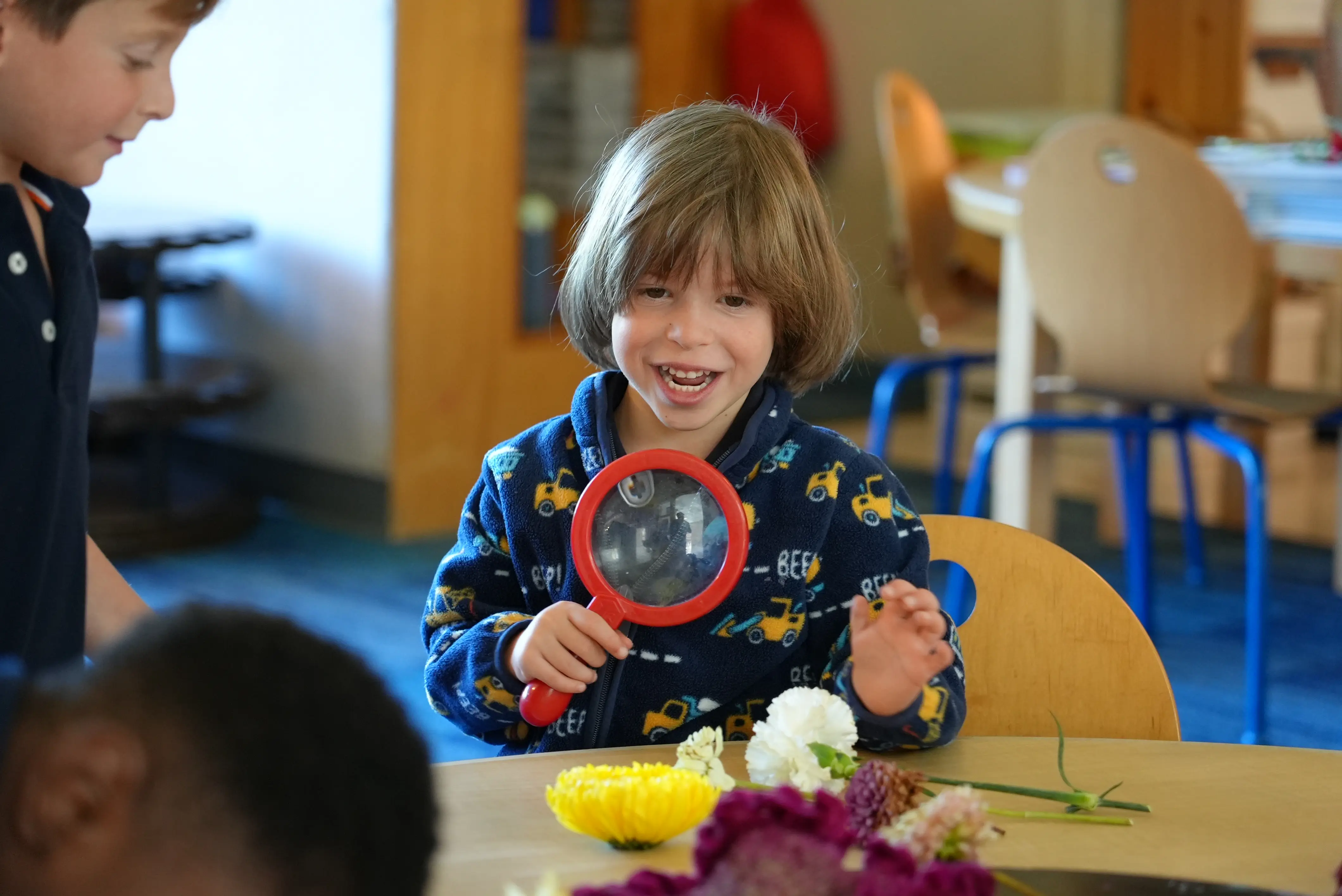
Young children arrive at school full of questions. Reggio-inspired teaching treats those questions not as a detour from the curriculum, but as a powerful starting point for it.
Teachers do more than provide answers. They help children wonder, notice, predict, investigate and make connections. That early habit - approaching the unfamiliar with interest and agency - can become the foundation for lifelong learning.
2. It makes collaboration and teamwork part of learning
Some learning happens independently. Other learning becomes possible only when children exchange ideas, negotiate roles, encounter a different perspective and solve a problem together.
In a Reggio-inspired classroom, relationships are part of the curriculum. Children learn to contribute to a group, articulate their thinking, listen with respect, build on a classmate's idea, negotiate roles and work through disagreement. They experience both the responsibility of being heard and the responsibility of making space for others.
These are not soft skills added after academics. Collaboration, teamwork and communication are how meaningful work gets done - in classrooms, communities and workplaces. Reggio gives children authentic opportunities to practice them from the beginning.
3. It develops communication across many forms
The Reggio concept of the hundred languages reflects the many ways children think, communicate and create meaning. A child may express an idea first through building, drawing, movement, storytelling, music or conversation.
Offering multiple pathways does not lower expectations. It gives teachers a fuller view of what a child understands and gives children more ways to develop and communicate increasingly complex thinking. Over time, they gain both competence and confidence: My ideas matter. I can make my thinking visible. I can keep working until others understand it, too.
4. It builds creative and critical problem-solvers
Open-ended investigations rarely have one prescribed path or one identical outcome. Children must decide what to try, notice what happens, explain their reasoning and revise their approach. Creativity generates possibilities; critical thinking helps children evaluate them.
This combination matters. Children learn that creativity is not limited to art and critical thinking is not limited to academics. Both are ways of engaging with a problem - and both become stronger through practice.
5. It strengthens adaptability, confidence and resilience
When a structure falls, a material behaves unexpectedly or a group's first plan does not work, teachers do not rush to remove every difficulty. With appropriate support, children learn to tolerate frustration, reconsider, negotiate and try again.
They begin to see themselves as capable people who can enter an unfamiliar situation without already knowing the answer. That belief is the beginning of adaptability and resilience.
6. It makes learning visible to families
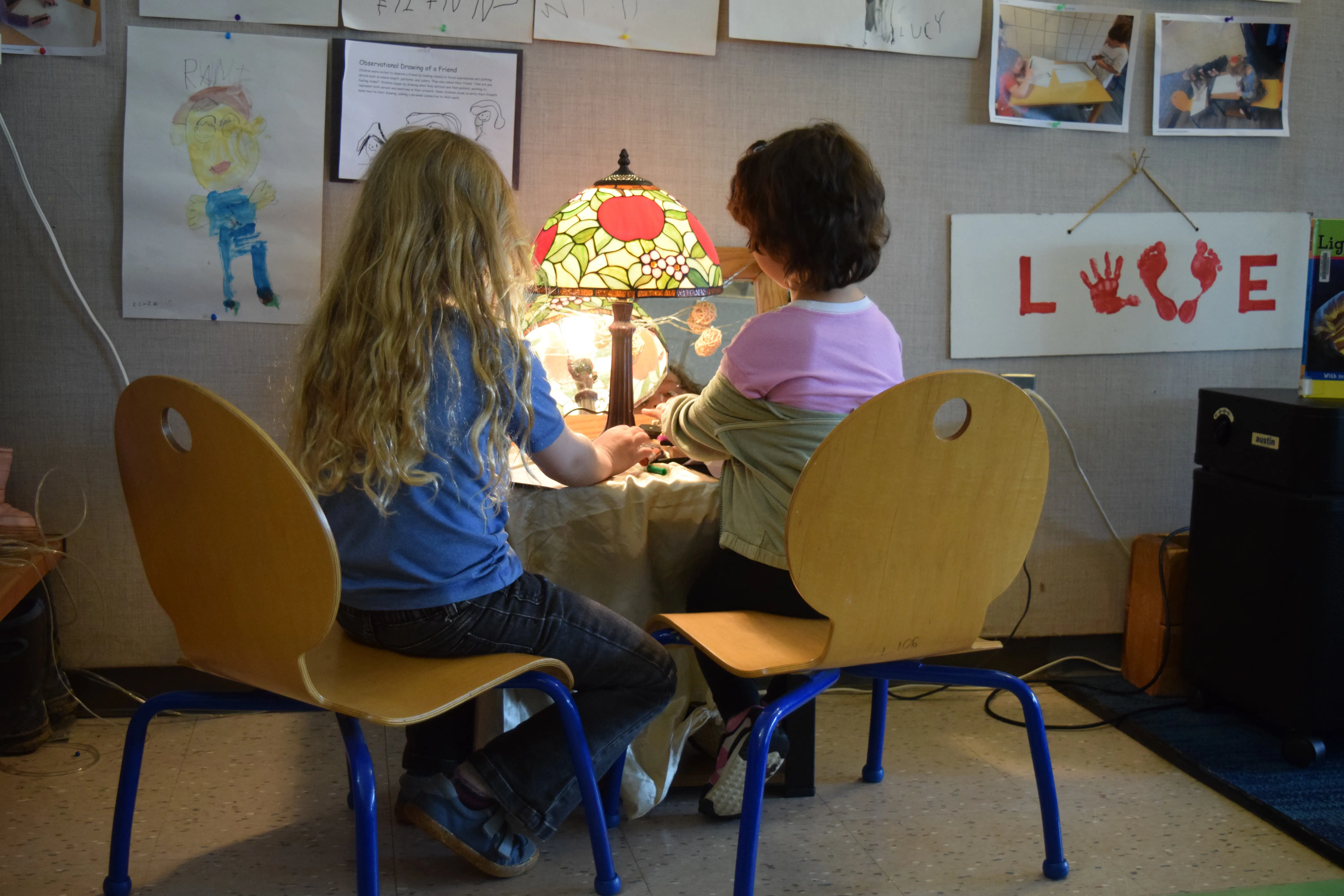
When a child brings home a painting, a parent sees the finished piece. Documentation helps reveal the learning behind it: the question that began the work, the choices the child made, the problem encountered, the conversation with a classmate and the new idea that emerged.
This practice allows teachers to study children's thinking and plan meaningful next steps. It also gives families a window into their child's growth and creates a richer partnership between home and school.
7. It builds the human capacities children will need in an AI-shaped world
Technology will continue to change what children need to know and do. For today's youngest learners, preparation for that future does not begin with more screen time. It begins with deeply human capacities: curiosity, creativity, judgment, empathy, communication, collaboration and the confidence to ask a better question.
A Reggio-inspired classroom gives children daily practice with ambiguity. They learn that an unfamiliar problem is an invitation to explore, that the first answer may not be the best one, and that ideas become stronger through testing, reflection and conversation.
The advantage of The Liggett Approach
At Liggett, Reggio Emilia is not an isolated preschool philosophy that ends when children enter kindergarten. It is the beginning of a coherent Early Childhood-Grade 12 journey built around student-centered, inquiry-driven learning.
- Two co-teachers in each classroom: Educators know children well and respond intentionally in individual, small-group and whole-group settings.
- An intimate, relationship-rich community: Children develop trust, belonging and the confidence to take appropriate risks.
- Purposeful provocations and open-ended materials: Children are invited to question, experiment, create and think critically.
- Foundational literacy and mathematics: Academic skills are woven through meaningful experiences and adjusted to children's development, interests and needs.
- Experiences beyond the homeroom: Art, music, yoga, outdoor exploration and the resources of an Early Childhood through Grade 12 campus expand learning.
- A close partnership with families: Communication and documentation help families understand and contribute to their child's growth.
- Continuity into Lower School and beyond: Increasing academic structure builds on the confidence, curiosity and joy of discovery established from the start.
The goal is not simply to prepare children for kindergarten. It is to help them become the kind of learners who are prepared for whatever comes next: observant, expressive, collaborative, curious, resourceful and eager to understand their world.
So, which approach is right for your child?
Montessori can be an excellent fit for families drawn to a highly structured environment of sequential materials, extended independent work and self-paced mastery.
Families may be especially drawn to Reggio Emilia when they want a program that places equal emphasis on curiosity, creativity, relationships, collaborative inquiry and multiple forms of expression - and when they want teachers to build learning responsively around the questions and capabilities of the children in front of them.
The best way to understand the difference is to see it. Visit a classroom. Look beyond the labels and ask:
- Are children's ideas visible and taken seriously?
- Can teachers explain not only what children are doing, but what they are learning?
- Do children have opportunities to think independently and with others?
- Are literacy and mathematics connected to meaningful experiences?
- Does the environment invite curiosity, conversation and discovery?
- Will this program know my child - and help my child become more fully themselves?
At University Liggett School, we believe the right beginning should do more than prepare children for the next classroom. It should help them love learning, trust their ideas and discover how much is possible when their curiosity is taken seriously.
Come see Reggio-inspired learning in action. Schedule a visit to University Liggett School.